From Non-Violence to Submission: How Did Hindu Society Become So Willing to Endure?
From Non-Violence to Submission
How Did Hindu Society Become So Willing to Endure?
One of the most difficult questions in history is not simply who defeated whom.
The harder question is this:
"What happens inside a society after it has been defeated again and again?"
Does its sword become weaker?
Or does its mind begin to change first?
When we read the history of India, an uncomfortable possibility keeps returning: did centuries of invasion, political defeat, social upheaval and humiliation gradually transform a powerful tradition of non-violence into a culture in which resistance and self-defence were increasingly pushed into the background?
This is not a question raised to insult Hinduism.
It is a question raised to make Hindu society look honestly at itself.
Because if a civilisation has weaknesses, those weaknesses cannot be corrected until they are acknowledged.
A Society That Placed Non-Violence on a Very High Pedestal
One of the remarkable features of Indian civilisation has been the high moral value it placed upon restraint and non-violence.
From the Upanishadic traditions to Buddhism and Jainism, and through several strands of Hindu religious thought, compassion towards living beings, self-control and ahimsa became powerful ethical ideals.
The fifth chapter of the Manusmriti, for example, repeatedly advises abstention from meat and speaks against causing unnecessary suffering to living beings. At the same time, the same text recognises ritual and other prescribed circumstances in which animal sacrifice was permitted. In other words, the actual Indian tradition was not a modern form of absolute vegetarian pacifism. Sacred Texts — Manusmriti, Chapter V
That distinction matters.
Because the real issue is not simply whether people ate meat.
"The deeper issue is how a civilisation understood violence and power."
Imagine a child raised from an early age with lessons such as:
Do not kill even a small creature.
Show compassion towards animals.
Respect life.
Control your anger.
Forgive.
Avoid causing pain to others.
These are beautiful civilisational values.
But there is another question.
Was that same child also taught:
"“If an innocent person is being attacked, standing in his defence is also your duty”?"
If that second lesson is missing, something is incomplete.
That is the point at which non-violence and cowardice begin to move in different directions.
Non-violence says:
"“I will not commit violence.”"
Cowardice says:
"“I will not stop the oppressor either.”"
Those are not the same thing.
But Our Own Scriptures Contain War
Someone may immediately ask: if Hindu society was so deeply committed to non-violence, then what was the Mahabharata?
It is a fair question.
The Bhagavad Gita begins on a battlefield.
Arjuna wants to lay down his weapons. Krishna does not simply tell him that violence is always wrong.
He reminds him of his duty as a Kshatriya and the obligation to fight for dharma.
Therefore, the foundational message of the Indian tradition was not:
“Never fight.”
There was another principle alongside it:
The use of necessary force against injustice is not necessarily opposed to dharma.
Al-Biruni’s eleventh-century India provides an interesting external account of this social ideal. In describing the Kshatriya, he portrays him as someone who should not fear danger, should advance in battle and should not retreat before the enemy. Columbia University — Al-Biruni's India
Elsewhere, he describes the Kshatriya as responsible for ruling and protecting the people. Columbia University — Al-Biruni's India
So it would be historically wrong to say that “Hinduism always taught cowardice.”
The harder question is:
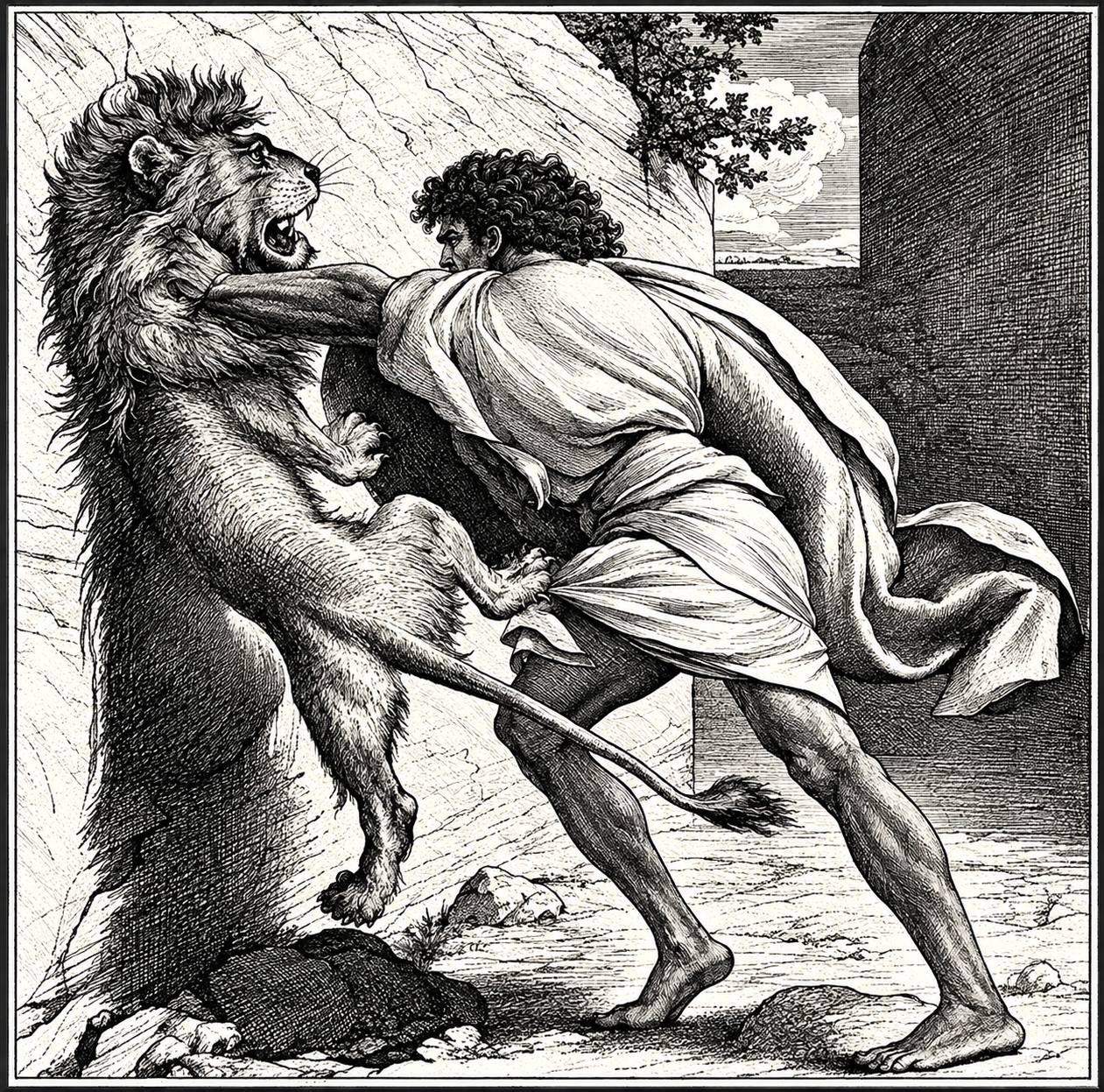
Why did the Kshatriya ideal not always become a collective social culture of resistance?
A Society Where One Section Fought and the Rest Watched?
This brings us to the uncomfortable subject of caste.
Al-Biruni describes the divisions between Brahmins, Kshatriyas, Vaishyas and Shudras and the different duties assigned to them. In his account, the Kshatriya was associated with political authority and protection, while other groups had different prescribed occupations and responsibilities. Columbia University — Al-Biruni's India
This system may have served as a form of social organisation in its historical context.
But it had another possible consequence when a civilisation faced external aggression.
"If weapons and political power become the responsibility of a relatively limited section of society, how strong does the collective military consciousness of the rest of society remain?"
That is a serious historical question.
Al-Biruni's account presents another uncomfortable fact. He describes restrictions on Vedic learning for Shudras and Vaishyas. Columbia University — Al-Biruni's India
So Indian society was not built only around spiritual ideals.
It also contained deep social divisions.
And when a civilisation faces an external threat, internal cohesion matters enormously.
Then Came the Ghaznavid Raids
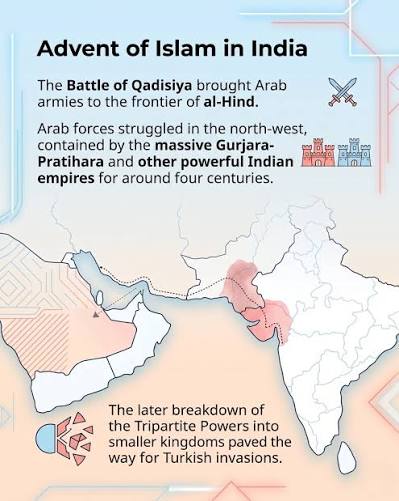
Now we reach the part of history that is difficult to read even without deliberately making it emotional.
Mahmud of Ghazni launched repeated campaigns into the Indian subcontinent.
His court historian al-Utbi's Tarikh-i-Yamini is one of the major sources for his campaigns. But there is an important qualification: al-Utbi was a court historian, and his account is therefore deeply shaped by the religious and political language of the Ghaznavid court.
Nevertheless, it would also be wrong to reduce his campaigns simply to modern concepts of political plunder and leave the religious dimension out of the picture.
The destruction of temples and idols appears as an important element in the descriptions of conquest.
The raid on Somnath became so deeply embedded in historical memory that its significance survived for centuries. Modern scholarship has shown how the story of Somnath later became a powerful political and cultural symbol in the making of Indian identity. Cambridge University — Somnath in a Play of Mirrors
But here, too, historical discipline matters.
Later writers added details to the Somnath story. Claims concerning exactly what happened to the idol and how its fragments were transported appear differently across sources. We therefore cannot treat every popular version of the story as a direct eleventh-century eyewitness account. Cambridge University — Somnath in a Play of Mirrors
That is what serious research means:
We must examine even the evidence that supports our own side.
War Does Not Only Break Bodies. It Breaks Morale.
Now comes the real issue.
Suppose a society repeatedly experiences the following:
A temple can be destroyed.
A king can be defeated.
A city can be looted.
People can be taken captive.
Wealth can be seized.
Families can be uprooted.
What happens then?
The consequences do not necessarily end with that generation.
Every generation tells the next generation stories about what happened to them.
That is how collective memory is created.
And collective memory can take two very different forms.
One society may say:
"“This happened to us. We will never allow it to happen again.”"
Another may gradually learn:
"“It is wiser to submit to the powerful and survive.”"
Indian history contains both traditions.
The Rajput tradition of resistance is one example.
The Maratha resistance is another.
The Sikh tradition is another.
But there were also long periods when local powers fought one another and external powers found opportunities to exploit those divisions.
Therefore, the problem was not simply a lack of bravery.
The lack of organisation and collective political consciousness was also part of the problem.
Now Compare This With Religious War-Language Elsewhere
This comparison may make some people uncomfortable.
But if we are genuinely researching history, we have to read the primary religious texts rather than avoiding them.
Qur'an 47:4, in the context of warfare, speaks of striking opponents, defeating them and then dealing with prisoners through release or ransom. Quranic Arabic Corpus — 47:4
That is harsh military language.
There is no reason to hide it.
But it would also be historically irresponsible to conclude from this that every Muslim behaves according to that verse. A religious text, its interpretation and the actual political behaviour of believers are three different things.
Nevertheless, the comparison remains interesting.
If one civilisation's religious literature contains strong language surrounding war, victory, struggle, martyrdom and captivity, while another civilisation increasingly gives greater social prestige to non-violence, renunciation and restraint, then it is legitimate to ask:
Can such different moral traditions have any influence on how societies perceive violence, defence and resistance?
That question has not been conclusively proven.
But asking it is not inherently sectarian.
It is a legitimate sociological and historical question.
Gandhi Himself Recognised the Danger
And here Gandhi becomes particularly interesting.
Gandhi was perhaps the most influential modern advocate of non-violence.
Yet Gandhi did not equate non-violence with helplessness.
He wrote:
"“My creed of non-violence is an extremely active force. It has no room for cowardice or even weakness.”"
He went on to argue that if a person could not defend his people, women and places of worship through non-violent means, he should at least possess the courage to defend them through physical resistance. Mahatma Gandhi — Political and National Life and Affairs
In another statement, Gandhi put the matter even more bluntly:
"“where there is only a choice between cowardice and violence, I would advise violence.”"
Mahatma Gandhi — Voice of Truth
This is important.
Gandhi's philosophy of non-violence was not a shield for the weak.
In his understanding, genuine non-violence demanded even greater courage than violent resistance.
Therefore, if a Hindu today interprets “ahimsa” to mean:
“I will witness injustice and remain silent because violence is sinful,”
then he has not understood Gandhi's concept of non-violence either.
The Real Problem: Not Compassion, but an Imbalance in Compassion
The criticism of Hindu society, therefore, should not be that it learned compassion.
That is one of the great achievements of Indian civilisation.
The criticism should be whether it ever allowed:
Non-violence to become detached from self-defence.
Forgiveness to become detached from justice.
Renunciation to become detached from strength.
And, most importantly:
Protection to become something regarded as the exclusive duty of the Kshatriya rather than a shared social responsibility.
If these things happened to some extent, then the weakness was not necessarily in the religious ideal itself.
It may have been in the social interpretation and institutional structure built around that ideal.
Then Came 1947
And history shook the Indian subcontinent once again.
The Partition of 1947 was not merely a line drawn across a map.
According to Cambridge University's account, more than 14 million people crossed the new borders between India and Pakistan, while approximately 750,000 people were killed, although estimates of the death toll vary between sources. Punjab experienced some of the worst violence. Cambridge University — A Tryst with Destiny
This story cannot honestly be reduced to one community being exclusively innocent and another being exclusively guilty.
Hindus, Sikhs and Muslims were all killed, displaced and forced to abandon their homes.
But the political reality of Partition must also be acknowledged:
British India was ultimately divided on religious lines, and Pakistan emerged as a Muslim-majority state.
Millions of people lost their homes, farms, businesses, memories and entire social worlds.
And the wound did not simply end in 1947.
Refugee families rebuilt their lives.
New social and economic networks emerged across Delhi, Punjab, Rajasthan, Uttar Pradesh and other regions.
One generation experienced the catastrophe.
The next generation heard its stories.
That is how collective memory survives.
But Did India Learn the Lesson?
This is perhaps the most difficult question.
After independence, India chose the path of a secular republic.
That was its constitutional choice.
Pakistan, by contrast, established itself as an Islamic Republic, and its Constitution recognises Islam as the state religion. Constitution of Pakistan — Pakistan Code
"That does not mean that secular ideas have no presence in Muslim-majority countries. Bangladesh, for example, simultaneously recognises Islam as its state religion while retaining secularism among the fundamental principles of state policy."
Therefore, the serious question is not the simplistic claim that “there is no secularism in Muslim-majority countries.”
The larger question is:
Did India apply secularism in a way shaped by the particular historical circumstances of its civilisation?
And did Hindu society sometimes suppress questions of cultural security, historical memory and civilisational self-respect in the name of political respectability?
That question remains open.
The Most Uncomfortable Conclusion for Hindu Society
It is easy to blame someone else after reading history.
The difficult task is to look inside one's own house.
If Hindu society was politically fragmented—that was our weakness.
If caste divided society into numerous compartments—that was our weakness.
If knowledge and power remained restricted to particular sections—that was our weakness.
If non-violence was sometimes interpreted as opposition to self-defence—that was our weakness.
If, after defeat, accommodation was sometimes treated as wisdom while resistance was treated as unnecessary—that too was our weakness.
But none of this proves that Hindu civilisation was inherently weak.
The same civilisation repeatedly produced traditions of resistance.
Therefore, the real question is not:
“Were Hindus cowards?”
The real question is:
What historical process caused a vast and extraordinarily diverse civilisation to sometimes combine compassion, tolerance and spirituality with a degree of social passivity that weakened collective self-defence?
There is no one-line answer.
To answer it seriously, we would have to examine caste structure, Kshatriya culture, temple economies, military organisation, rural society, the position of women, memories of invasion, the Bhakti movements, colonial education and Gandhian politics together.
In the End
A civilisation does not have to become brutal in order to survive.
It has to become alert.
If the next generation of Hindus is taught only:
"“Do not harm any living being,”"
then the education is incomplete.
They must also be taught:
"“Do not allow an innocent person to be harmed.”"
They must learn that forgiveness is noble—but only when it does not arise from fear.
Gandhi expressed the same principle differently: refusing violence because of weakness is not non-violence. He regarded non-violence as a quality of courage. Mahatma Gandhi — Voice of Truth
Therefore, the renewal of Hindu society should not mean learning to hate another religion.
It should mean rediscovering the strength within its own civilisation.
It should mean:
Reading history without fear.
Acknowledging our own failures.
Remembering the suffering inflicted upon us as well.
Preserving compassion.
But never again losing the will or the ability to defend ourselves.
Because perhaps the harshest lesson of history is this:
A society that begins to regard its own strength as a sin may eventually pay the price for its freedom.
And a society that places its strength under the discipline of dharma can carry both compassion and resistance at the same time.
Let there be non-violence. But not fear. Let there be forgiveness. But not submission. Let there be compassion. But let the courage to protect one's own people stand above it.